
Named in this strand



September 2026 / The attempted sale
Buyers deterred. Marketing stopped.
Mr J’s 13 September warning, the agent’s 15 September feedback and 22 September withdrawal letter, and Miss E’s 24 September Council complaint now have a connected record. Eight questions distinguish Mayo’s conduct from the Council’s responsibility to verify its own documents.
Read the sale-interference investigation and full context · The evidence route for future claims and damages
The family’s allegation
A home must not become leverage for a knowingly improper demand.
Miss E and Mr J allege that costs, enforcement and the expansion of the claim were used to pressure a vulnerable homeowner—and then another person with an interest in her home—for financial advantage. They call for investigation of what they describe as attempted extortion.
The point requiring examination is concrete: what relationship did anticipated recovery against the house have to the decision to pursue each person, and what actual liability supported the sums demanded? The June letter gives that inquiry a documentary starting point. It is not, by itself, proof of an unlawful demand.
Mark John Mayo: identify the evidence for the accusations, the liability behind the demands and the grounds for pursuing the home.
Mr J’s letters / Read the record
The demands were put in writing. Read them in full.
Two complete letters set out Mr J’s financial-verification challenge to Luke Oliver Keith Cornwell and Seldons LLP. They are presented as his contemporaneous allegations and arguments, alongside the firm’s response and this investigation’s analysis of recoverable liability.
Mr J · 5 January 2026
The demand: substantiate the financial representations.
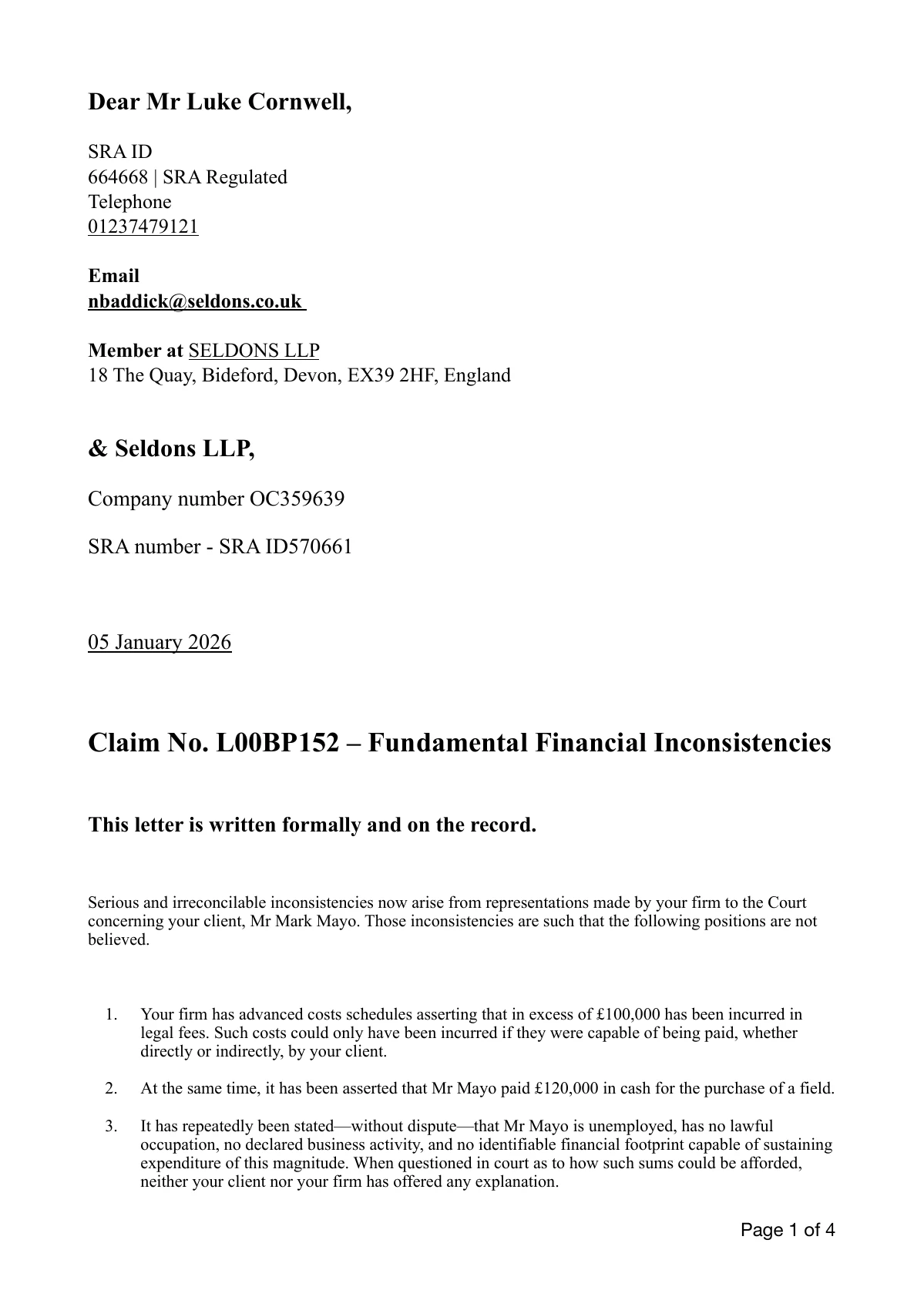
“This issue is not peripheral. It goes directly to whether the costs advanced to the Court were real, recoverable, and lawfully attributable to your client at all.”
The originating letter demands documentary verification of the costs and field-purchase representations, asks for the payment pathway and requires preservation of billing, client-account and source records.
Mr J · January 2026 reply
The challenge: the refusal does not answer the substance.
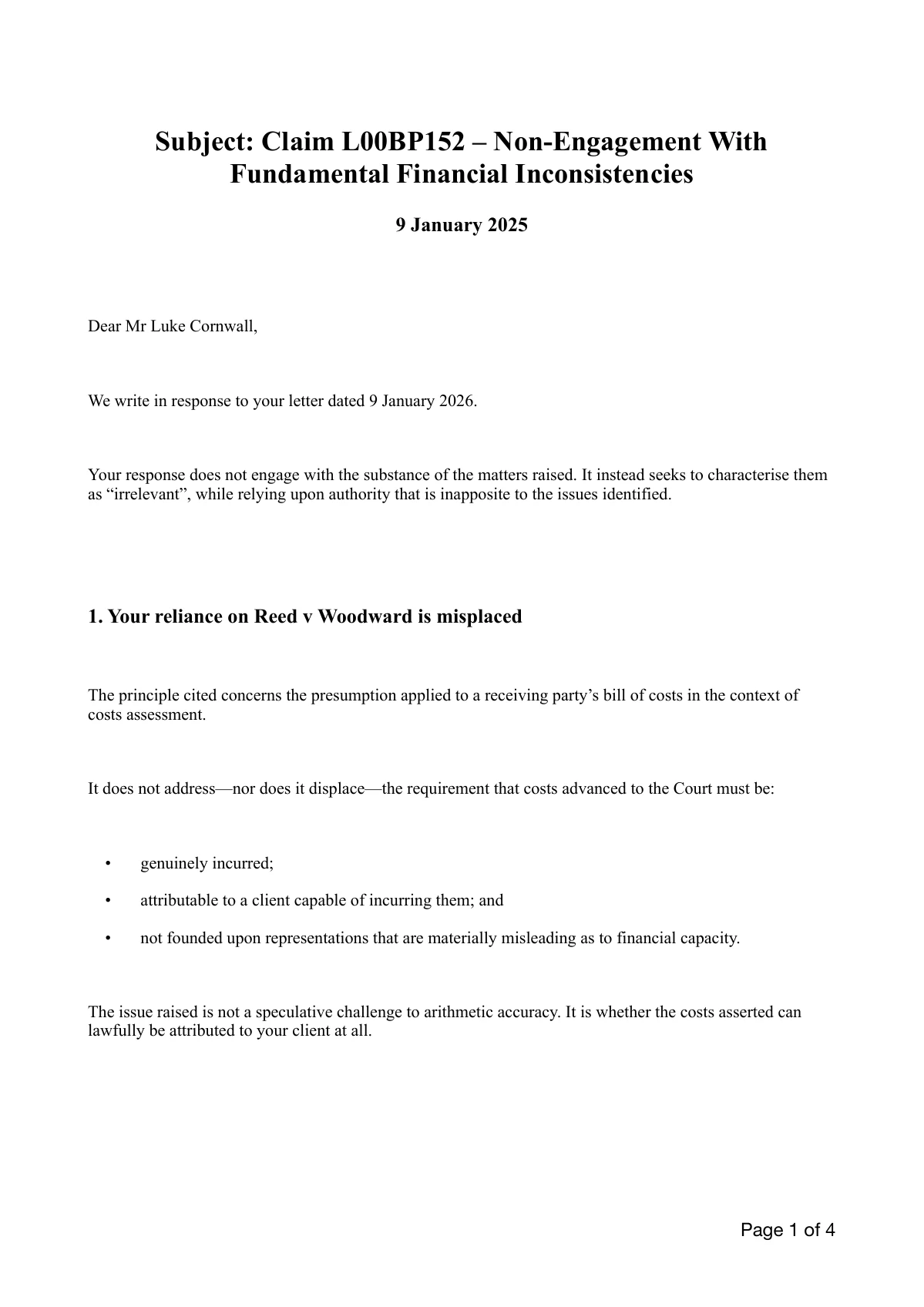
“Your response does not engage with the substance of the matters raised.”
Mr J challenges the refusal, records the unanswered verification demands and asks how the costs can be attributed to the client. The reply also disputes the characterisation of his correspondence.
The reply is also available: Seldons’ complete 9 January 2026 response · Payment, incurred liability and conditional funding · Requests and responses.
The source prints “9 January 2025” but expressly answers the firm’s 9 January 2026 letter. The apparent year error is retained in the document.
Miss E’s intended action / Follow the evidence
Alleged extortion. Allegedly wrongful accusations. One connected inquiry.
Miss E’s stated intention is to pursue a claim against Mark John Mayo arising from these allegations. This records a planned claim, not confirmation that a new claim has been issued. The legal basis and remedies remain to be settled; “wrongful accusations” describes her complaint, not an established finding or a shorthand for a particular cause of action.
The demands: what was sought, and what was threatened?
Start with Seldons’ 23 June 2025 letter expressly connecting the house, anticipated enforcement and adding Mr J. Identify each demand, author, date, sum or concession, stated grounds and threatened consequence. Read the letter and joinder documents · Follow the ownership chronology.
The money: what supported each claimed liability?
Match the demand to its schedule, work, rate, enforceable liability, credits and assessment. Follow the requests and replies, the original March N260 dispute and the separate company-payment/VAT account. January demands and response · April answer · Blohm costs and VAT record · Original N260 and enforcement.
The accusations: identify the words and test them against the record.
For each accusation Miss E says was wrongful, identify who said it, to whom, when, the evidence relied on, her answer and the decision that followed. This route connects the amended allegations and public-authority accounts; it does not assume they were all made by the same person or proved false. The amended allegations and earlier events · Police–Council evidence and replies · Annex E objections and the court filing record.
The consequences: account for the pressure and the harm.
Connect each alleged act to its documented financial or personal consequence: the bank restriction, enforcement steps, costs burden and reported effects on life at home. Keep the intended claim separate from the existing appeals and any proposed criminal or regulatory referral. The bank-order hearing · Writ and attempted enforcement · Home-life evidence and written warnings · The legal test and records still required.
The question is not whether the family can withstand more pressure. It is whether the accusations and financial demands can withstand scrutiny.
Status of the intended claim · Direct question to Mark John Mayo
The house and joinder were expressly connected—in writing.
On 23 June 2025, Seldons said Mayo would seek to enforce a damages or costs award against the house. The letter then stated:
“In the event [Mr J] becomes the registered proprietor of [the property], we will apply to add or substitute him as a defendant to these proceedings.”
“In the unlikely event we are unable to enforce any award of costs and/or damages against you, we will seek to enforce them against him.”
— Seldons’ letter, trial bundle pages 655–656; identifying words replaced in brackets. Source and full context
Luke Oliver Keith Cornwell, Seldons LLP and Mark John Mayo: what part did recovery against the home play in the decision to pursue Mr J, and what independent merits justified each claim?
The firm’s stated explanation was suspected transfer of the property to put it beyond enforcement. The family disputes the motive and says the home became the point of pressure. Examine that disagreement against the sequence—not speculation about anyone’s lifestyle.
- 7 June 2024: Seldons treated Mr J as a non-party.
- June 2025: ownership correspondence and the enforcement-and-joinder letter.
- 15 July / 2 September 2025: joinder listed, then ordered by Paul Mitchell (Designated Civil Judge for Cornwall, Devon and Dorset; Exeter Combined Court Centre).
- 23 September 2025: amended particulars alleged acts by Mr J in 2024 and sought damages and costs against the defendants.
- 14 October 2025: the legal-title registration date later reported by Mr J.
The September order is not expressly boundary-only. The family disputes the difference between its understanding of the oral explanation and the amended claim. Adding claims about earlier events is not the same as backdating joinder. Orders, amended particulars and the disputed scope · Ownership and the later objection
Who was liable, for what—and on which terms?
The family suspects a conditional-fee arrangement and challenges whether claimed costs reflect actual obligations. The reviewed material does not establish that arrangement or that Mayo paid nothing. The demand is for the recoverable liability, not a guess about his bank balance.
- Paid
- Money already transferred: identify the invoice, payment and any credit.
- Incurred but unpaid
- A liability may exist before a bill is paid: identify the obligation and work it covers.
- Conditional
- Identify the relevant condition and recoverable amount. A CFA can lawfully support costs recovery.
- Estimated, claimed or awarded
- A forecast, a party’s demand and a court award are different figures. Reconcile them rather than adding them together.
CPR 44.1(3) expressly permits recovery in specified conditional arrangements. A missing receipt does not prove no liability. But an assertion of liability should be tested by the applicable costs procedure and accurate supporting records. The demands sought payment evidence or enforceable liability
Requests were made. The firm declined financial verification.
Mr J’s January 2026 demands sought evidence behind substantial costs representations. Seldons’ 9 January response rejected the requested documents as irrelevant, opposed disclosure and said the challenge confused incurred and estimated costs. On 1 April, the firm said prior invoicing or payment was unnecessary if the client was liable and declined further comment on private funding arrangements.
Which requested records are genuinely irrelevant or protected—and which document or certificate establishes the liability being passed to the opposing party? That is a targeted question for Cornwell and the firm, not a demand to publish unrelated personal finances or privileged advice. January requests and response · April answer in context
HDI Global / Seldons LLP / Browne Jacobson
Fraud allegations reached the firm. What reached its insurer?
HDI Global: are you aware of the formal allegations of fraudulent documentation and financial misrepresentation against Seldons LLP and Luke Oliver Keith Cornwell? Did you receive the allegations and evidence in full—and when?
Mr J expressly requested insurance details so potential claims could be notified. Seldons named HDI Global, and identified Browne Jacobson LLP and Gary Oldroyd as its insurance contact. The reply contained no policy number. The family challenges whether it was given a complete, usable route to the insurer and whether the insurer received the substance of its allegations.
8 January 2026: a request for the actual insurance particulars
“Seldons LLP is requested to confirm the details of its professional indemnity insurance, including the identity of its insurer(s) and the applicable policy number(s), so that appropriate notification may be made”
Mr J’s preservation and escalation notice, section 5.3, page 7. The passage links the request to potential claims arising from the matters recorded in the notice. Read the full chronology, source details and rules
9 January: an insurer name and a lawyer—not a policy number
“we confirm that our insurers are HDI Global whose agents are Browne Jacobson LLP”
The reply from Cornwell also supplied Gary Oldroyd’s professional email. It did not identify the policy number, claim reference or date of notification. Its wording did not prohibit direct contact with HDI. The demand now is to complete the disclosure and produce the notification trail.
24–27 March: the firm requests a letter before claim; two are supplied
On 24 March Cornwell asked for a letter before claim which the firm could provide to insurers. Miss E’s 27 March reply attached separate letters concerning costs schedules and enforcement without the N260. Were both forwarded, with their supporting material, and on what date?
1 April: the firm invokes its insurer’s solicitors
“We have notified our insurer’s solicitors and they are content for us to respond directly given that they agree your proposed claims are clearly vexatious.”
— Seldons, Your Purported Letters Before Claim, 1 April 2026, page 1. The letter disputes the proposed claims and their particularisation. Who authorised the position attributed to insurer solicitors, and what evidence had those solicitors seen? The April letter does not name them; Browne Jacobson is asked to confirm whether it was the firm concerned.
Show the notification record—not just a lawyer’s name.
Seldons and Cornwell: identify the policy, its notification requirement, the event that triggered it, and the date you complied. HDI: confirm receipt. Browne Jacobson: confirm your mandate and the accuracy of the position attributed to insurer solicitors.
Rule 9.2 requires insurer identity, policy number and claims contact details on request where the asserted claim falls within minimum-terms cover. Notification timing must be tested against the applicable policy; there is no single SRA deadline triggered by every fraud allegation. SRA insurance rules and minimum terms
The SRA is also asked to assess the completeness of the January disclosure. The family should not have to guess which policy responds or whether its evidence reached the insurer.
Read the five direct insurer-notification questions · Read the full chronology, source details and rules · Responsibility and the recorded response
These follow-up questions are published for scrutiny; they have not yet been sent by this publication.
“The company pays” is not the VAT calculation.
Mr J reports that, at the 22 May 2026 hearing, Mayo described paying a company which then paid his legal expenses, and Blohm allowed 20% VAT without supporting evidence being shown. The exact exchange will be checked against the transcript; this wording is a paraphrase of Mr J’s account.
The company identified in the family’s inquiry is Mayo Media 2015 Ltd, company 09412563, of which Mark John Mayo is a director. The account must establish which company and invoices were actually involved. Public company identity · Mark John Mayo, Mayo Media and British Dealer News: business background
Who was the legal-services client? Who incurred the liability? Could the receiving party recover VAT as input tax? What evidence answered that question before VAT was charged to Miss E?
PD44 paragraphs 2.3–2.5 exclude VAT the costs receiving party is able to recover as input tax, including the recoverable proportion where entitlement is partial. They require a certificate when entitlement is disputed, or supporting evidence at the hearing for a litigant in person. A company paying an individual’s bill does not itself establish a business expense, tax deduction or input-tax recovery. The relevant accounting treatment and entitlement must be identified. The actual VAT rule · HMRC: determining business use · Director’s loan accounts
Mark John Mayo / Company records / HMRC remit
Show the tax treatment—not just the payment route.
Was any part of Mark John Mayo’s personal litigation treated as a company expense for tax? Was any VAT recoverable? What records reconcile that treatment with the costs claimed from Miss E?
Mr J’s reported account of the hearing raises a checkable question for Mayo and the publisher’s management. A vulnerable person facing a costs demand should not have to guess what “the company pays” means. Identify the company, the invoices, who owed the fees and how the payments were recorded.
- Payment: who actually paid, and whose money was used?
- Accounting: was it recorded as remuneration, a director’s loan, reimbursement or another arrangement?
- Corporation Tax: was a deduction claimed, for what amount and on what basis?
- VAT: who received the legal services, who was entitled to recover input tax, and what supported VAT being included in the costs award?
These are distinct questions. An unexplained payment route answers none of them. HMRC recognises lawful treatment of directors’ private expenses as remuneration or through a loan account; properly taxable remuneration can be a deductible company employment cost. No actual deduction or VAT recovery has been established in this inquiry. HMRC: directors’ personal expenses · HMRC: remuneration and company deductions.
The immediate costs question: was VAT recoverable by the receiving party?
Under PD44 paragraphs 2.3–2.5, a costs claim must exclude VAT the costs receiving party is able to recover as input tax; only the non-recoverable proportion belongs in the claim. Where entitlement is disputed, the rule requires a certificate from the legal representative or auditors, or supporting evidence at the hearing for a litigant in person. That is not automatically the VAT position of a separate company handling payment. A Corporation Tax deduction is a different matter: it reduces taxable profit and is not a VAT refund or an automatic pound-for-pound reduction in a costs award. Read the actual VAT rule.
Mr Mayo and the relevant company: identify the accounting basis and the evidence supporting the VAT claim. If the reported company-payment account is wrong, correct it with the record. MEDIA-05: the full question to Mark John Mayo and publisher management · The hearing account, orders and full costs context.
HMRC: the proper route for a substantiated tax concern.
HM Revenue & Customs is the appropriate authority to assess a tax-compliance concern if evidence shows an improper deduction, VAT claim or other incorrect reporting. It does not decide Miss E’s costs appeal. A referral should identify the entity, dates, sums, relevant statements and records, separating documented facts from suspicions. Official HMRC reporting route.
HMRC generally cannot disclose a taxpayer’s returns or confirm investigation details. Asking publicly whether it is “aware” will not produce the company’s tax record; confidentiality is not evidence of approval or inaction. The public demand for an explanation is therefore directed to Mayo and the relevant company. HMRC’s confidentiality rules.
No report has been sent to HMRC by this publication. Naming HMRC here does not notify it. Its reporting guidance says not to send supporting documents initially, but to explain that records are available if requested.
Tax sources and scope of the inquiry · Mayo’s business background and all five publisher questions
Company-level follow-up
British Dealer News / Mayo Media: identify the entity and explain any role.
Was this business involved in paying or processing Mayo’s legal expenses? If so, show the relevant records; if not, say so. Five questions ask the publisher’s management to identify the legal entity, Mark John Mayo’s role, any payments and authorisation, and the records relevant to the reported hearing account, VAT and tax treatment.
Read the five questions to publisher management · Verified directorship and publisher background · Full hearing and costs context
These are proposed follow-up questions, not a statement that the magazine or its staff funded or participated in the alleged conduct.
Two costs stages. One demand for the complete calculation.
The April order already included VAT. The reported May exchange must not be presented as the first appearance of VAT in this costs sequence.
- 23 April 2026: the reviewed order allows £600 plus VAT and records consideration of the bill and evidence.
- 18 May: Cornwell acknowledges the N260 incorrectly used Grade A, says Grade B at £247 plus VAT applied, and offers £7.20 plus VAT off the claim.
- 22 May: hearing before Blohm; the company-payment exchange is reported by Mr J.
- 23–26 May: Miss E requests the sealed order, transcript and breakdown. Her 26 May statement reports a substituted £1,000 inclusive figure.
Leslie Adrian Blohm (Senior Circuit Judge and Designated Civil Judge, Bristol; appointed to the Western Circuit in October 2022): identify the evidence, the fee and rate corrections, the VAT treatment and the arithmetic. How was the final amount reached, and where can the person ordered to pay examine that basis?
The hearing notice’s inclusion of Mr J is a further, distinct caption objection raised by Miss E. It does not establish that this separate application made a costs order against him. Orders, grading correction, hearing notice and contemporaneous demands
The earlier costs foundation is still part of this story.
The March 2025 assessment, the family’s demand for its N260 and service record, subsequent enforcement and the later disclosure refusal remain separately documented. Later N260s and company-payment explanations do not answer the demand for that original schedule.
Original costs, service claim and enforcement · The TPDO hearing and representation changes · Blohm’s later disclosure refusal and the protective appeal · Separate £120,000 field-transfer document challenge
Test the allegation of extortion against the actual demands.
The family is asking whether the financial pressure was knowingly improper. An investigation should identify the particular demands, threatened consequences, grounds asserted, sums sought, knowledge of inaccuracies, intended gain and resulting harm. That record—not modest possessions, a company directorship or suspicion of a CFA—is what can establish or defeat the allegation.
The potential criminal test for blackmail under section 21 of the Theft Act 1968 requires an unwarranted demand with menaces and an intention to gain or cause loss. Whether a demand is unwarranted involves the maker’s beliefs about its grounds and the use of menaces. Lawful litigation and enforcement do not become blackmail simply because they are distressing. CPS: the elements that must be established
SRA: examine the representations, the acknowledged grading error and the documentary connection between ownership and enforcement. State what you assessed and why. The regulator’s professional-conduct remit and the court’s costs-assessment powers are different. These questions seek scrutiny, not a declaration that any crime has already been proved.
The people and organisations asked to answer
HDI Global — Insurer name supplied by Seldons on 9 January 2026; exact underwriting entity and policy requested.
Browne Jacobson LLP — Named by Seldons as HDI Global’s agents; Gary Oldroyd identified as the contact.
Mark John Mayo — Claimant; director of Mayo Media 2015 Ltd.
Luke Oliver Keith Cornwell — Solicitor, Seldons LLP.
Seldons LLP — Claimant’s solicitors.
Leslie Adrian Blohm — Circuit judge; April–May 2026 costs proceedings.
Paul Mitchell — Judge; September 2025 joinder order.
Solicitors Regulation Authority — Professional-conduct oversight—not the costs assessment court.
Read all 15 precise questions and their evidence links · Read the full documentary chronology
The historical correspondence has its own sending dates. These consolidated publication questions are prepared for follow-up and have not been sent by this publication.