
The invoice identifies a firm. The statements leave the author unspoken.
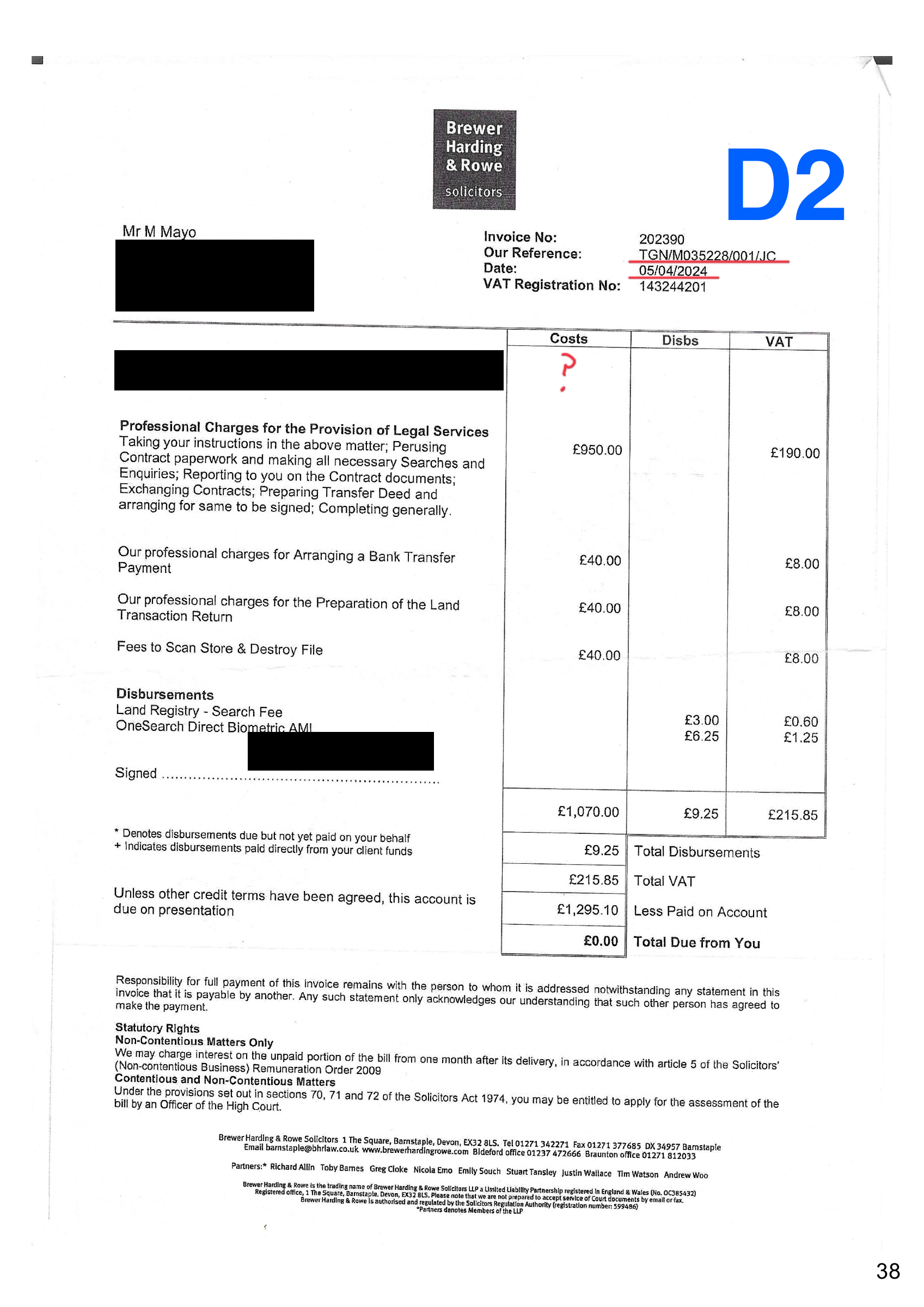
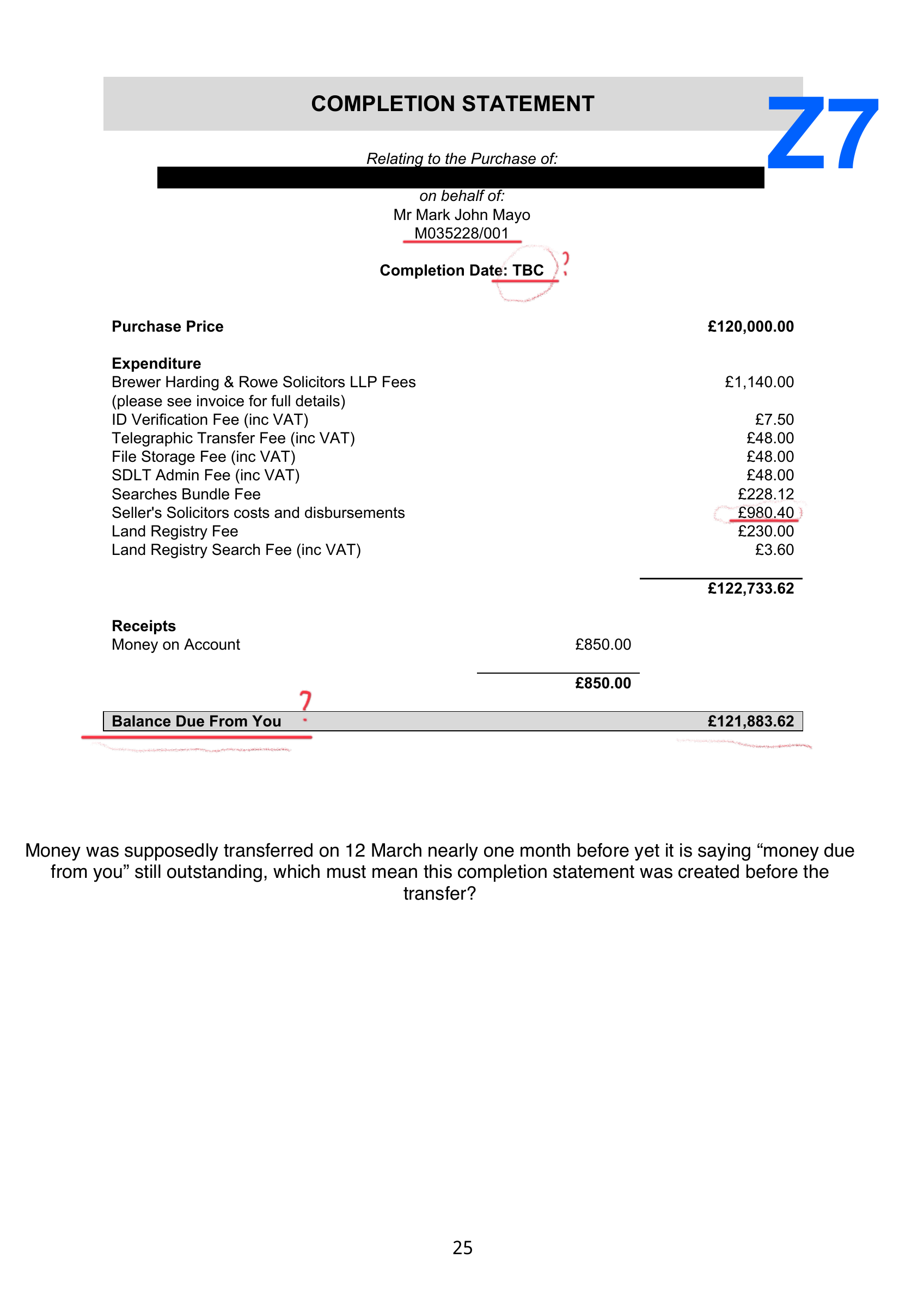
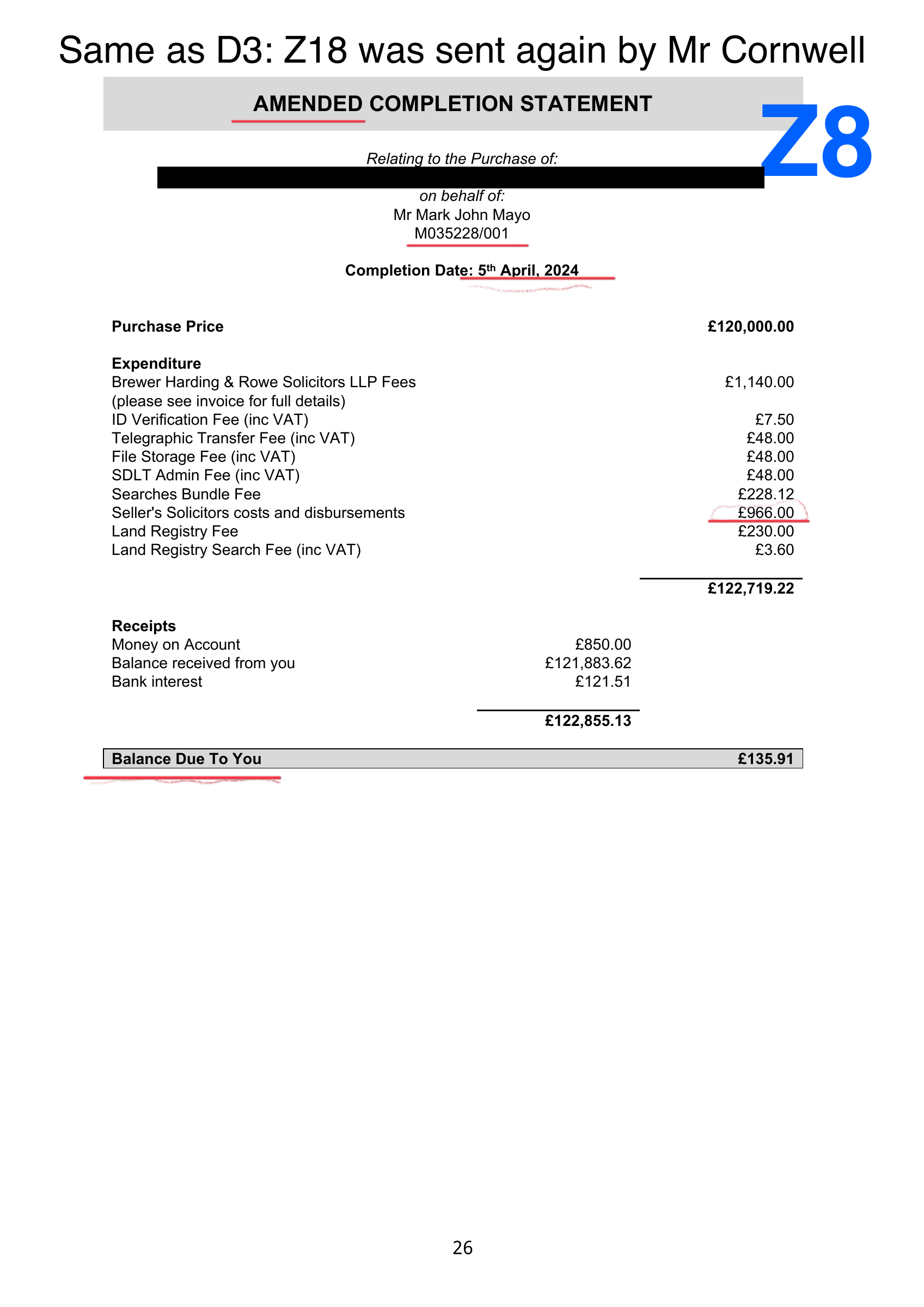
Invoice 202390, dated 5 April 2024, displays Brewer Harding & Rowe’s letterhead, contact and regulatory details and reference TGN/M035228/001/JC. The two statements instead show M035228/001, without a named preparer, visible signature or the invoice’s letterhead and regulatory footer.
Both statements still identify Mark John Mayo, the transaction and a Brewer Harding & Rowe fee entry. The issue is reduced issuer identification and the absence of direct authentication—not a claim that every identifier has disappeared.
D2 · Invoice 202390 · 5 April 2024
Z7 · Completion date “TBC”
Z8 · Amended statement · 5 April 2024
The exhibit labels and added commentary were added in Mr J’s submitted evidence; they are not the issuing firm’s wording.
| Feature | Invoice D2 | Statements Z7 / Z8 |
|---|---|---|
| Letterhead / regulatory footer | Present | Absent |
| Reference | TGN/M035228/001/JC | M035228/001 |
| Named preparer | No printed preparer name; signature mark present | None visible |
| Firm identification | Letterhead and footer | Firm named in a fee entry |
| What it records | £1,295.10 fees, shown paid on account | Purchase price, costs and funds required / received |
The accompanying letter dated 5 April 2024 bears the typed name Tim Nock (registered as Timothy George Nock, SRA 146856) and the full reference. It expressly says completion has taken place, encloses an amended statement and says a £135.91 refund will be arranged. That is a claimed link to the amended statement. Will BHR authenticate the letter and the exact enclosure together?
These are different document types, not demonstrated before-and-after versions of the same file. The concrete challenge is to identify the original template, preparer and dispatch history—and establish whether the shorter reference was original or introduced later.
Who is named—and who actually made the documents?
Timothy George Nock (Tim Nock), individual SRA 146856, is identified as the solicitor on the 5 April 2024 letter. Julia Corrick is expressly listed as his secretary. The letter carries BHR’s 29 Bridgeland Street, Bideford, Devon, EX39 2PT office address.
The full reference is TGN/M035228/001/JC; both completion statements retain M035228/001. Nock and BHR: identify each preparer, approver and sender, explain those reference components, and authenticate the original files. Confirm Corrick’s role, if any, in preparing or dispatching this packet.
Verified firm registration and office details → · Individual SRA register · The exact authentication question →
Source: Exhibit D, SRA exhibit packet, physical p. 54; professional identity checked against the SRA register on 26 September 2026.
12 March → 5 April 2024
24 days apart. Show the complete payment trail.
The reproduced bank page shows a £121,883.62 debit on 12 March 2024. The invoice and stated completion date are 5 April 2024: 24 days later. The £120,000 purchase price is one part of that larger sum, not the debit amount itself.
- 12 March: the bank copy. It records £121,883.62 leaving the account. This review has not independently authenticated that copy or the corresponding receiving-account credit.
- 5 April: the amended statement. It records receipt of £121,883.62 and a £120,000 purchase price. It therefore is a record asserting receipt; it is not independent banking confirmation.
- The unresolved link: the seller’s payment. The compared papers do not provide an independently authenticated client-account ledger, onward £120,000 transfer and seller-side acknowledgment that establish the complete route of the money.
Pre-completion funding is not itself an anomaly, and a fee invoice is not a client ledger. The material question is what records connect the March debit to the April completion and actual seller payment.
The figures reconcile. Authentication is the outstanding issue.
Z7 shows expenditure of £122,733.62, less £850 already received, leaving £121,883.62 to pay. Z8 reduces the seller-side costs by £14.40 and credits £121.51 bank interest to the client. Together these produce the £135.91 refund described in Nock’s letter. Repeating the fee amount in an invoice and a completion statement does not establish a second charge. A consistent calculation does not, however, independently establish that the underlying transfers occurred.
Where is the matching credit, the onward payment and the refund record? Relevant entries can be verified without publishing unrelated private banking information.
Exhibit D4 / An authentication challenge raised before the strike-out hearing
A different address. One bank page. Authenticate the source.
The bank copy includes “Cottage”. The conveyancer’s invoice does not. Miss E and Mr J challenge whether the page presented as Mark John Mayo’s HSBC statement faithfully reproduces a bank-issued record, apart from identified redactions. This is not a new objection: section 4 of the 14 October 2025 strike-out rebuttal raises the address discrepancy; Mr J’s later SRA filing expands the allegation.
| Record | What is visible | What needs an answer |
|---|---|---|
| D4 · Bank-page reproduction | “Cottage” is an additional line in the address. | Did HSBC hold that address and issue this exact page for Mayo? |
| D2 · Conveyancer’s invoice | “Cottage” is absent from the address. | What explains the difference between the two records? |
| D4 · Statement period | 3 March–2 April 2024; visible transactions end on 19 March with a balance carried forward. | Where are the continuation pages and the bank-origin copy? |
The supplied copy also leaves bank-identifier fields blank. Who supplied this page to Luke Oliver Keith Cornwell and Seldons LLP, and who redacted or otherwise changed it? The source file, original transmission and bank confirmation can test those questions. An address mismatch alone cannot determine whether the bank held a variant address or someone altered the document.
The financial test is equally direct: does the £121,883.62 debit correspond to a verified receipt in Brewer Harding & Rowe’s client account and a payment onward for the field? Match the bank-origin transaction to the conveyancer’s ledger—not simply one disputed copy to another.
FT-07: authenticate the bank page and explain its source → · FT-08: test the bank record against the client ledger →
Keep the challenge precise: dates, costs and account ownership
March 2024 is not March 2025. No Seldons-labelled payment is visible on this page, but it predates the disputed costs assessment by a year. The 21 March 2025 order records £3,500 assessed and £1,750 payable. This partial 2024 statement cannot establish whether those later costs were incurred or paid. The official N260 certificate concerns costs a party is liable to pay, not only payments already made. Read the separate costs-record challenge →
A person’s occupation does not identify the owner of a bank page. Companies House lists Mark John Mayo as a director of Mayo Media 2015 Ltd, appointed in 2015. A 2016 industry account describes his involvement in the publication founded by Colin Mayo and Roger Willis. Neither that history nor the absence of a salary entry on one page establishes ownership or forgery. No independently verified record identifying another account holder has been located in this review.
The publication’s demand: establish the bank record’s origin, explain the address and verify the transaction. That is a specific, answerable challenge to evidence used in litigation affecting Miss E and Mr J’s property.
“From the conveyancing solicitor” needs an original transmission.
The family received the disputed material through Seldons. Miss E’s 7 October 2025 SRA complaint, forwarded again on 26 September 2026, attributes this explanation to Cornwell:
“The documents originated from our client’s conveyancing solicitor, were sent to him electronically and have been printed off.”
Her complaint says Tim Nock emailed the four-document packet to Mayo on 14 July 2025, before it was presented at the 15 July hearing. Mr J’s separate SRA filing says Cornwell represented that documents came directly from BHR. These are accounts in the complaints: the underlying source email has not been located in this review, and “sent to him” must not silently become “sent directly to Seldons”.
Seldons’ actual 17 October 2025 disclosure letter supplied documents described as its client’s non-privileged conveyancing file. It identified redactions of a national insurance number and the sellers’ addresses. That letter does not itself assert direct BHR-to-Seldons receipt.
Cornwell and Seldons: identify the sender, date, original attachments and every subsequent change. BHR: confirm whether the copies match the files you issued. An attributed origin can be tested against the original sending record.
Why this belongs in Annex E—not in a footnote.
The dispute concerns the documentary foundation advanced for Mayo’s field purchase and the reliability of papers used in the litigation. Mr J’s SRA submission particularises alleged fabrication in section 4.1 (bank material) and section 5 (completion statements). Miss E’s separate complaint brings the purported conveyancing firm’s role into focus.
This branch sets out the observed differences, the family’s allegation and the records capable of resolving it. It connects to the wider Annex E document-integrity challenge, without treating the separate BH68, expert-report and purchase issues as proof of one another.
Return to Annex E’s conveyancing strand → · Read the post-hearing disclosure chronology → · Follow the separate expert-report branch →
The records to test—not simply another assertion.
SRA Accounts Rule 8.1 requires accurate, contemporaneous, chronological client-ledger records of receipts and payments. That makes the underlying ledger an obvious authentication source for a regulatory investigation. It does not give an opposing party automatic public access to a client’s entire confidential file.
The demand is proportionate: authenticate the exact documents and verify the relevant transactions through a lawful disclosure or regulatory process.
Direct questions / Proposed by this publication
Who can answer—and what must they produce?
FT-01
Did your firm issue these exact completion statements?
To: Brewer Harding & Rowe Solicitors LLP · Timothy George Nock (Tim Nock)
Brewer Harding & Rowe: authenticate the exact TBC and amended completion statements displayed here. Identify each preparer, creation date, approval and original dispatch. Your letter and invoice show TGN/M035228/001/JC; the statements retain M035228/001 but omit the outer components, letterhead, regulatory footer and named approval. Was this your original template, or was either statement changed after issue? Identify the original files and explain the difference. Tim Nock is the signatory named on the accompanying completion letter; what does the firm’s record establish about that letter and its enclosures?
Why it matters: The visible difference is reduced issuer identification. The original files and dispatch history can establish whether these copies are genuinely the firm’s records.
FT-02
Who supplied the statements to Seldons—and where is the original email?
To: Luke Oliver Keith Cornwell · Seldons LLP
Luke Oliver Keith Cornwell and Seldons LLP: identify precisely which documents you received, from whom, when and in what format. Miss E’s complaint quotes an explanation that they originated from the client’s conveyancing solicitor and were sent electronically to him; Mr J’s separate filing alleges a representation of direct receipt from Brewer Harding & Rowe. Produce the original explanation and source transmissions so those accounts can be resolved. Identify the sender, recipients and original attachments for the alleged 14 July 2025 transmission, and the files used in July and 17 October disclosure.
Why it matters: An attribution repeated in a complaint is not the original source email. The chain from issuer to client, solicitor and court should be identifiable.
FT-03
Where is the verified payment to the seller?
To: Brewer Harding & Rowe Solicitors LLP · Mark John Mayo
The bank-page reproduction displays a £121,883.62 debit on 12 March 2024 and the amended statement records the same receipt. Identify the matching client-account credit and ledger entries, then the onward payment of the £120,000 consideration and the seller-side acknowledgment. Reconcile any combined remittance with seller costs, the £121.51 interest credit and the £135.91 refund. What independently authenticated records establish those transactions, and how do they connect to this field purchase?
Why it matters: The question is not whether a payment amount appears on the papers: it does. It is whether the receipt and onward purchase-price payment can be independently verified.
FT-04
What was issued before the 12 March payment?
To: Brewer Harding & Rowe Solicitors LLP · Timothy George Nock (Tim Nock)
Identify when the TBC funding statement was first created and sent, and the instruction under which the £121,883.62 was transferred on 12 March 2024, 24 days before the 5 April invoice and recorded completion. Provide the original covering communications and explain the seller-cost reduction from £980.40 to £966 and the interest period and calculation. The figures reconcile; what contemporaneous records verify the dates and transactions behind them?
Why it matters: Funds can be requested before completion. The unresolved issue is the actual creation and dispatch sequence, not the mere fact that money preceded the final invoice.
FT-05
What was changed between the source files and the court copies?
To: Luke Oliver Keith Cornwell · Seldons LLP
Identify every redaction, conversion, reformatting, selection or other alteration made between the original source files and the versions disclosed in July and October 2025. Who performed and checked each change? Did anyone change the matter-reference components? The 17 October letter describes specified privacy redactions and attaches conveyancing-file material. Identify which pages and covering letters were supplied on each occasion, preserve the originals and explain any differences without treating all later exhibit annotations as part of the issuer’s documents.
Why it matters: The comparison raises a provenance question. An authenticated earlier version or reliable edit history is needed to establish whether identifiers were deliberately removed.
FT-06
Did the regulatory assessment test the actual source and money trail?
To: Solicitors Regulation Authority
Identify whether the SRA obtained authentication of these exact statements from Brewer Harding & Rowe, the original transmission trail and the relevant client-account records. Which records were examined and what reasons address the particular provenance and payment allegations? Keep the Seldons complaint RGC-000162355 separate from the Brewer Harding & Rowe / Tim Nock complaint RGC-000171182, and identify the decision and later material considered in each. What further evidence would be required to test any unresolved allegation of fabrication or misleading court use?
Why it matters: The regulator’s response should identify what was tested, not merely whether the complaint was received. Separate complaint files must not be merged into a single purported finding.
FT-07
Will you authenticate the bank page and explain the address?
To: Mark John Mayo · Luke Oliver Keith Cornwell · Seldons LLP
Mark John Mayo, Luke Oliver Keith Cornwell and Seldons LLP: does HSBC confirm that Exhibit D4 faithfully reproduces a bank-issued record for Mayo, apart from identified redactions? Its address includes “Cottage”; the conveyancer’s invoice does not. Explain that difference against the bank’s contemporaneous record. Identify who supplied the page, when, in what original format, and who made any redactions or other changes. Where are the original transmission and continuation pages for the 3 March–2 April 2024 statement? Provide bank-origin verification through consent or the appropriate disclosure process, without publishing unrelated private banking data.
Why it matters: The address mismatch is visible and was challenged in the October 2025 rebuttal. Authentication must establish the source of the actual page relied on—not infer ownership from spending patterns or occupation.
FT-08
Will you test the disputed bank record against the firm’s ledger?
To: Brewer Harding & Rowe Solicitors LLP · Solicitors Regulation Authority
Brewer Harding & Rowe: identify the verified client-account credit corresponding to the £121,883.62 debit shown on 12 March 2024, its client-ledger posting and onward completion payment. Did the bank page reach the firm in this exact form, and what original files or verification records can establish its source? SRA: did either relevant complaint assessment test the address discrepancy, source transmission and bank-to-ledger match? Identify the records examined, the findings and any authentication still outstanding. Keep the bank-record inquiry separate from the March 2025 costs dispute.
Why it matters: A matching amount on two disputed documents is not independent bank confirmation. The receiving account and contemporaneous client ledger provide a direct test of the claimed purchase-funding trail.
The complaints and disclosure correspondence above are historical records. These consolidated publication questions have not yet been sent. A response identifying the documents checked will be linked here.
Source record
- 103-page SRA exhibit packet: D p. 54 (Nock letter); D2 p. 55 (invoice); D3 p. 56 (amended statement); p. 57 (bank reproduction); Z1 pp. 64–65 (17 October disclosure letter); Z7 p. 89 and Z8 p. 90 (statements). Page numbers are physical PDF pages.
- Mr J’s 25-page SRA submission, RGC-000162355: section 4.1, pp. 15–18; section 5, pp. 19–24. These contain his allegations, not SRA findings.
- Miss E’s 7 October 2025 BHR complaint: six-page report and four-page hearing-document attachment, reread in the email forwarded on 26 September 2026.
- 14 October 2025 strike-out rebuttal: section 4, physical p. 6, challenges the bank address and purchase-payment record. The later 25-page SRA complaint, physical pp. 15–18, develops those allegations; it is not a bank-authentication finding.
- Costs and company records: the official N260 certificate and Companies House appointment record are linked beside the points they address above.
- Accounting standard: SRA Accounts Rules, rule 8.
Read the allegation, evidence and conditional legal significance → · Continue through the case →
The reporting record
What changed in this article.
- Annex E branch · Bank-record challenge added
The £120,000 field purchase: authenticate the statements and bank record.
Compare the invoice and completion statements, then examine the “Cottage” address difference on the bank copy. Eight named questions seek the original files, bank confirmation and the receiving client-account record.
Read the bank-record challenge
Substantive additions and corrections will be recorded here. The full case can be followed through Latest developments.
Stay with the story
Follow the investigation
as the record develops.
Follow what changes when another document, account or answer enters the record.
Follow Daux Scythe, our presenter, on LinkedIn for new reporting, evidence reviews and significant developments. The website remains the home of the articles, documents and response record.
This opens his profile; choose Follow on LinkedIn.