
Miss E’s detailed rebuttal · Five direct challenges
The findings themselves are challenged.
An admission she disputes. Evidence she says she could not answer. An incident described as outside the case, then assessed against her. Follow the particular objections, their consequences and the questions to Timothy Edmund Walsh.
Filed 12 August 2026 · KA-2026-BRS-000028
Miss E’s eight appeal grounds are now in the record.
Bias, the opportunity to answer evidence, property findings, disclosure and £64,800 in costs: follow the actual filed challenge to Timothy Edmund Walsh’s judgment, then the detailed objections developing behind it.
Particular allegations · Specific records · Direct questions
Ten challenges. Each requires a specific answer.
Procedure
Was the case against Mr J properly defined and put before the court?
Evidence
Where were the contrary accounts and documents examined?
Consequences
What protection remained for the home—and who bears the costs?
The following follows the statement’s own numbered sequence. Each point links to the relevant page image and the connected reporting.
Challenge 01 · Statement page 3
Which claim was the court deciding?
Mr J says no court-issued, sealed amended claim naming him was identified or produced, and that the claimant accepted serving an unsealed version. He challenges the decision to dispense with service without first identifying the operative court document. He also says he was blamed for raising a defect in documents controlled by the claimant.
Why this matters: The identity and scope of the pleading matter to the claim a person must answer. A service ruling should be traceable to an identifiable document and recorded reasons.
AP-01 · The answer sought
Identify the operative claim and amended pleading, the original issue record, the amendment order and the filed version. Which document’s service was dispensed with, under which rule, on what evidence and for what reasons? Where was Mr J’s precise objection determined?
Questions for Timothy Edmund Walsh · HMCTS court-file administration · Luke Oliver Keith Cornwell (SRA 664668; solicitor and partner, Seldons LLP, Bideford, Devon) · Seldons LLP
The statement invokes CPR 2.6 and 6.16. Rule 2.6 addresses sealing on issue; rule 6.16 addresses dispensing with claim-form service in exceptional circumstances. The question requires the original issue record and the amendment/service record, not merely the appearance of one served copy.
Challenge 02 · Statement page 3
A boundary-only joinder—or liability for the entire dispute?
Mr J says he was not a party for approximately eighteen months and that the Mitchell hearing transcript confines his joinder to the boundary issue. He alleges that the amended claim merged the defendants and historical allegations instead. He says Simon Brilliant also raised the scope problem, which remained unresolved.
Why this matters: A late-joined party needs to know which allegations and remedies are pursued against them. The scope of joinder also connects directly to costs.
AP-02 · The answer sought
Identify the order and transcript passage defining Mr J’s joinder. If the claim against him extended beyond the boundary, where was that extension authorised, which allegations were included and what opportunity was he given to answer them?
Questions for Timothy Edmund Walsh · Luke Cornwell — Seldons LLP · Seldons LLP
Challenge 03 · Statement pages 3–4
If the trial fee was paid, identify the record.
The statement describes three weeks of requests before trial for a receipt, payment reference or remission record. Mr J says none was supplied to him and that Walsh accepted an assurance from the court instead. He alleges unequal treatment of this procedural objection.
Why this matters: The payment question is capable of a documentary answer. A dated ledger or remission record would resolve the factual dispute.
AP-03 · The answer sought
What was the trial-fee deadline, and what dated payment or remission record satisfied it? Identify the fee notice, the entry relied on, and any order addressing default or relief. Why was that record not supplied when it was repeatedly requested?
Questions for Timothy Edmund Walsh · HMCTS court-file administration
CPR 3.7A1 links trial-fee consequences to the fee notice, payment/remission position and applicable deadlines. The issue to establish is what happened in that record—not whether a receipt was merely absent from the family’s correspondence.
Challenge 04 · Statement pages 4–5
Where was the opportunity to answer the adverse account?
Mr J challenges the treatment of CCTV and contemporaneous evidence concerning late-night disturbance, gates left open, lights, idling vehicles, rubbish and security. His statement expressly records that substantial evidence was not completely filed while they awaited the trial-fee decision. He says the court knew of up to fifteen recordings but did not properly receive, view or assess the relevant material before making adverse findings.
Why this matters: The challenge concerns both the evidence and the process for receiving it. It asks whether disputed conduct was judged with its surrounding context and a fair opportunity to respond.
AP-04 · The answer sought
Which recordings and documents were filed, offered or excluded? Identify the admission decisions and reasons, the precise conduct underlying each adverse finding, and the opportunity given to answer it. Where was the contemporaneous context examined?
Questions for Timothy Edmund Walsh
Challenge 05 · Statement page 5
The photographs demanded an answer. Where is it?
The statement sets the reported “one tree” account against the dated aerial sequence, machinery, cut timber, planning material and use of the route. Miss E attended the trial and records the claimant’s statement in her account; Mr J attended delivery of the judgment. He challenges the conclusion he reports hearing about the scale of felling. His point is the combined evidential record, not a photograph in isolation.
Why this matters: The scale and purpose of the activity go directly to the disputed use of the access beside a vulnerable Grade II-listed historic home—and to whether Miss E’s safety concerns were treated as genuine.
AP-05 · The answer sought
Which dated images, machinery photographs and route-use evidence were considered? Identify the passage reconciling them with the claimant’s cutting account and the finding on the scale of activity. Where were the resulting vehicle movements and risks to Miss E assessed?
Questions for Timothy Edmund Walsh · Luke Cornwell — Seldons LLP · Seldons LLP
Challenge 06 · Statement page 5
A right of access. What happened to the safeguards?
Mr J says the 1987 conveyance imposed reciprocal safeguards covering maintenance, gates, security, damage, nuisance and proper use of the route. He alleges longstanding non-compliance, describes the unsafe gate encountered during the site visit, and disputes the claimant’s refusal to contribute to its replacement. He also recalls Offen recognising a problem with the way the route was being used.
Why this matters: The family challenges the practical result: access for the claimant, but no effective answer to the protections they say accompanied the grant.
AP-06 · The answer sought
Which conveyance obligations remained enforceable, what findings were made on the alleged breaches and what practical protection did the order preserve? Identify the reasons addressing the gate, maintenance, disturbance and vehicle-safety evidence.
Questions for Timothy Edmund Walsh · Luke Cornwell — Seldons LLP · Seldons LLP
Challenge 07 · Statement page 6
BH68: where is the instrument supporting the competing entitlement?
The statement says no wayleave in Mark John Mayo’s name for BH68 was produced, that the receipts did not themselves identify BH68, and that reliance shifted to a 1963 Badslake agreement in another owner’s name, predating subdivision. Mr J says National Grid had described the historic agreement as defunct. He contrasts that claim with Miss E’s agreement, apparatus plan, history and payment record.
Mark John Mayo — claimant in L00BP152; Higher Barley Hayes, Torrington area, Devon · Case identity and source record
Why this matters: The pole’s position links the documentary dispute to the boundary. The question is the chain connecting a specific right, apparatus and parcel of land to the person claiming it.
AP-07 · The answer sought
Identify the current agreement, assignment, transfer or other instrument establishing the claimed BH68 entitlement. How does it connect the historic land and named owner to Mr Mayo, and where did the judgment reconcile it with Miss E’s agreement and plan?
Questions for Timothy Edmund Walsh · Luke Cornwell — Seldons LLP · Seldons LLP
Challenge 08 · Statement page 6
What made the alleged stakes a legal boundary?
Mr J challenges the preference he says Walsh gave to the claimant’s assertion that stakes may once have existed. He says the previous owners did not recognise them and described a retained strip at the bank’s top for access and hedge maintenance. He alleges that this evidence was rejected without adequately reconciling the plans and the land’s history.
Why this matters: The difference affects land ownership and the position of the fence. The statement demands a reasoned comparison of the competing evidence.
AP-08 · The answer sought
What evidence established the stakes’ existence, position and significance as a legal boundary? Where were the previous owners’ retained-strip account, relevant plans and physical history compared, and why was that account rejected?
Questions for Timothy Edmund Walsh
Challenge 09 · Statement page 6
The £120,000 transaction: show the verifiable chain.
The statement raises specific concerns about the bank and conveyancing material: an address containing “Cottage”, the absence of a Seldons payment in the March 2025 statement, the timing of an alleged payment to Brewer Harding & Row before its invoice, and an invoice recording smaller payments but not the alleged £120,000. It also challenges missing identifying details on a later completion statement.
Why this matters: Mr J alleges that the purchase evidence was accepted without resolving those discrepancies. The direct test is the original transaction and client-account trail, with private banking details protected.
AP-09 · The answer sought
Which original records establish the £120,000 payment, receipt, holding and application on completion? Identify the corresponding ledger entries, dates and authenticated completion record. Where did the court determine each discrepancy raised in the statement?
Questions for Timothy Edmund Walsh · Luke Cornwell — Seldons LLP · Seldons LLP
Challenge 10 · Statement pages 6–7
Whose costs, for which issues, from what date?
Mr J challenges what he describes as undifferentiated costs liability. He asks why he should bear costs from before his joinder, or costs for issues outside its scope, as though he had been a defendant from the beginning.
Why this matters: This is the July judgment’s costs-allocation challenge. It connects to, but is distinct from, the earlier March 2025 N260 and summary-assessment dispute.
AP-10 · The answer sought
Identify the reasons allocating costs by party, issue and period. Which costs predate Mr J’s joinder, which concern the boundary and which concern the right of way? What legal and factual basis supports imposing the disputed portions on him?
Questions for Timothy Edmund Walsh · Luke Cornwell — Seldons LLP · Seldons LLP
The allegation is the pattern—not one isolated disagreement.
Mr J’s final position is that the combined handling of pleadings, joinder, fees, evidence, property rights and costs deprived the family of a fair opportunity to present its case. He alleges that the court excused defects supporting Mr Mayo’s position while making adverse findings against Miss E and Mr J without confronting their contrary material.
Where is the reasoned answer to that combined challenge? A response should identify the operative documents, the evidence considered and the passages deciding each objection.
The statement invokes Porter v Magill [2001] UKHL 67, paragraph 103: apparent bias is assessed through a fair-minded, informed observer considering whether there is a real possibility of bias. Mr J argues that the cumulative record meets that test.
“I will not allow what happened to Miss Evans, myself, and Lower Barley Hayes to be reduced to the judgment’s version alone.”
Mr J’s statement, page 7
This challenge was sent to the courts.
- 18 August 2026: date printed on the eight-page statement.
- 19 August 2026: signature date on its statement of truth.
- 19 August, 16:22: Sent Items records the email “Claim No. L00BP152 - Statement for the Court Record and Public Record” to Plymouth’s court office, copied to the civil appeals mailbox, other court offices and legal representatives.
- 19 August, 16:23: Barnstaple’s automated reply acknowledged receipt of the email.
The email asks for the statement to be placed on the court file and brought to the attention of the judge dealing with Miss E’s appeal or related applications. Its seven attachments comprise this statement, three dated aerial-image files labelled 2017, 2021 and 2025, and three photographs: IMG_5497, IMG_5518 and IMG_5493. See the connected photographic source record →
The acknowledgement establishes email receipt at Barnstaple; the next record sought is its placement on file and consideration. The statement’s references to Walsh’s findings are Mr J’s challenge, not extracts presented here as a certified judgment transcript.
Read the document yourself
The eight-page statement.
These are page images of the reviewed copy, not a retyped reconstruction. Personal identifiers, the contact block and signature are visibly covered; the substantive wording is unchanged. Open a page, then use its full-size link to enlarge it.
Page 1 — Opening allegation, recipients, purpose and statement date.
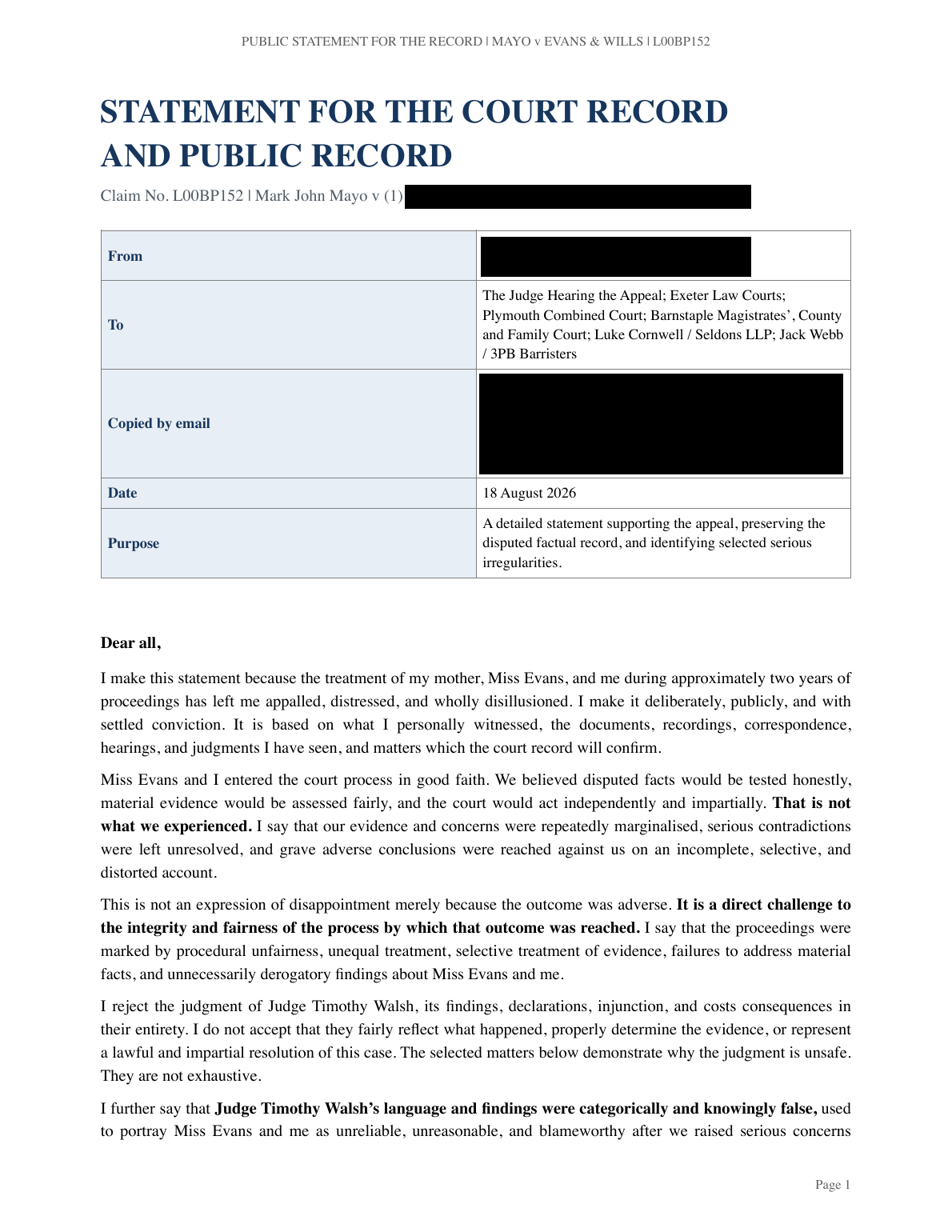
Page 2 — The wider challenge to the treatment of the family and the proceedings.
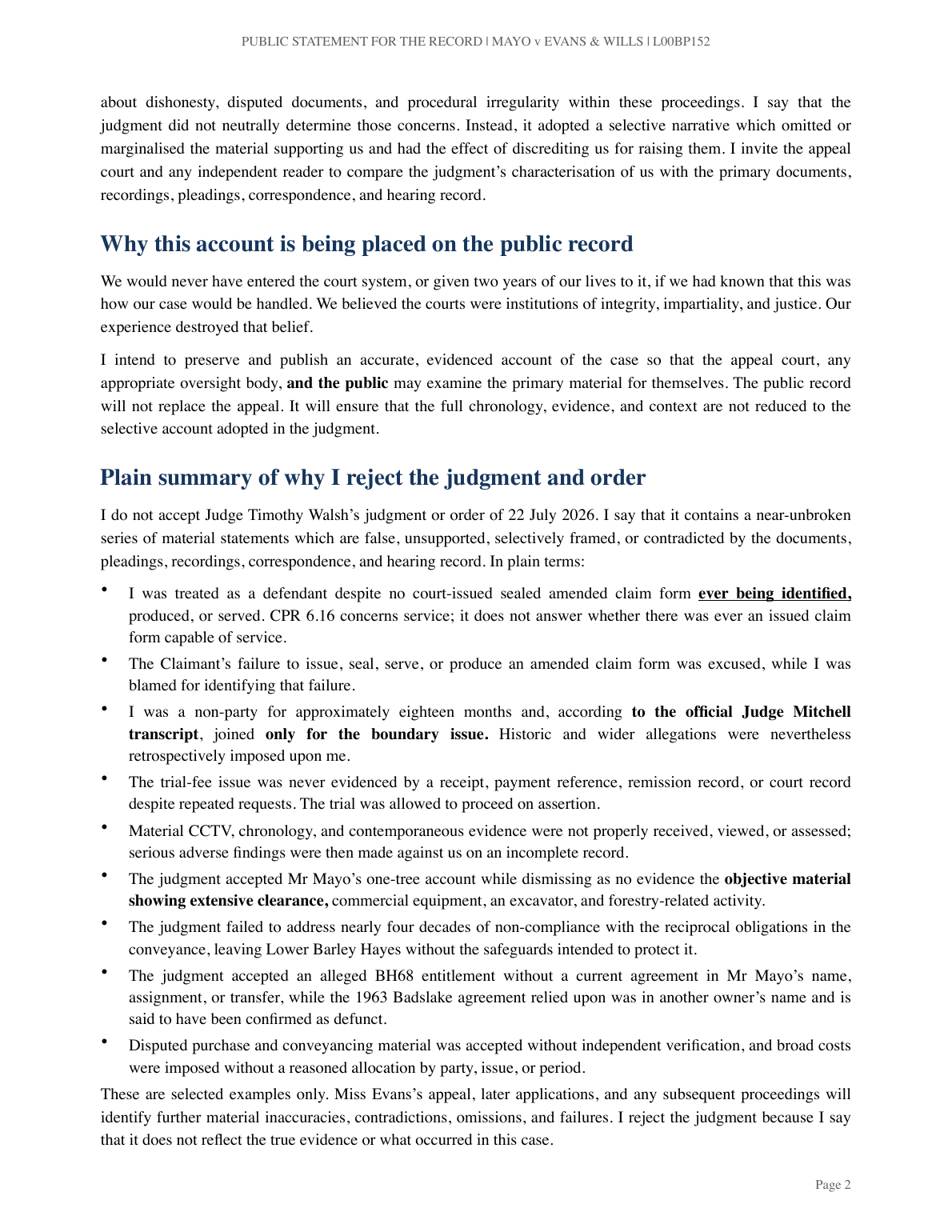
Page 3 — Points 1–3: operative claim, scope of joinder and trial fee.
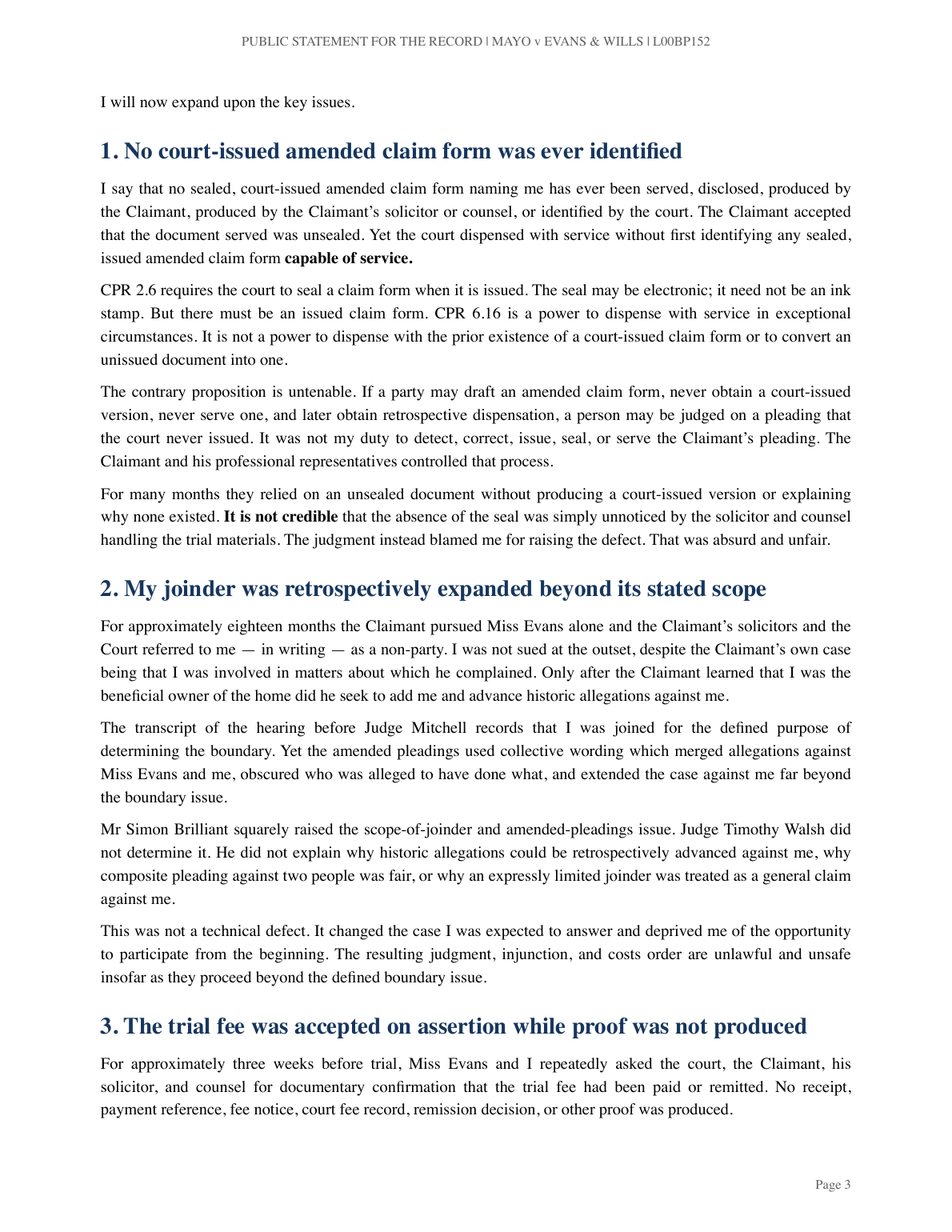
Page 4 — Points 3–4 continued: trial-fee challenge and contemporaneous evidence.
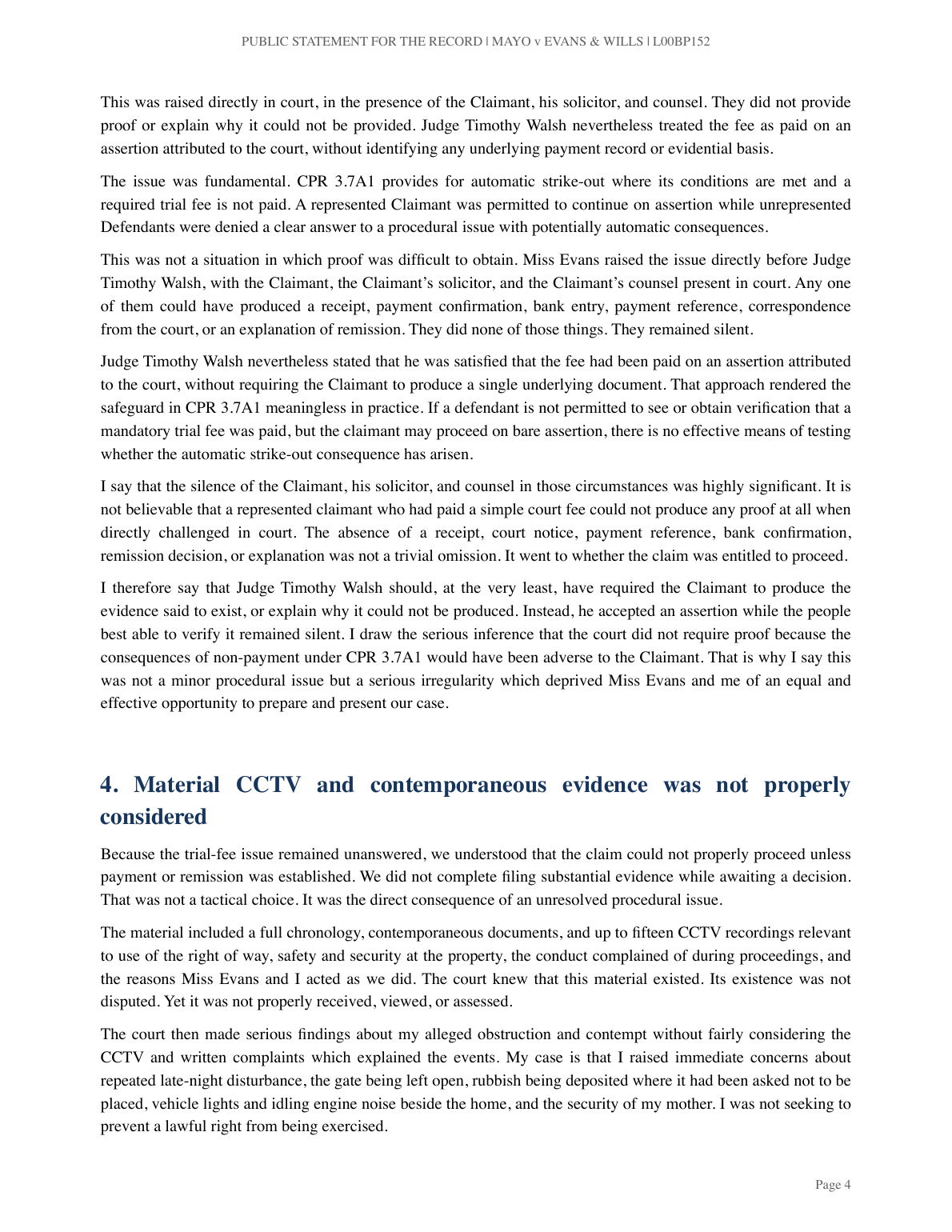
Page 5 — Points 4–6: evidence context, felling and the conveyance safeguards.
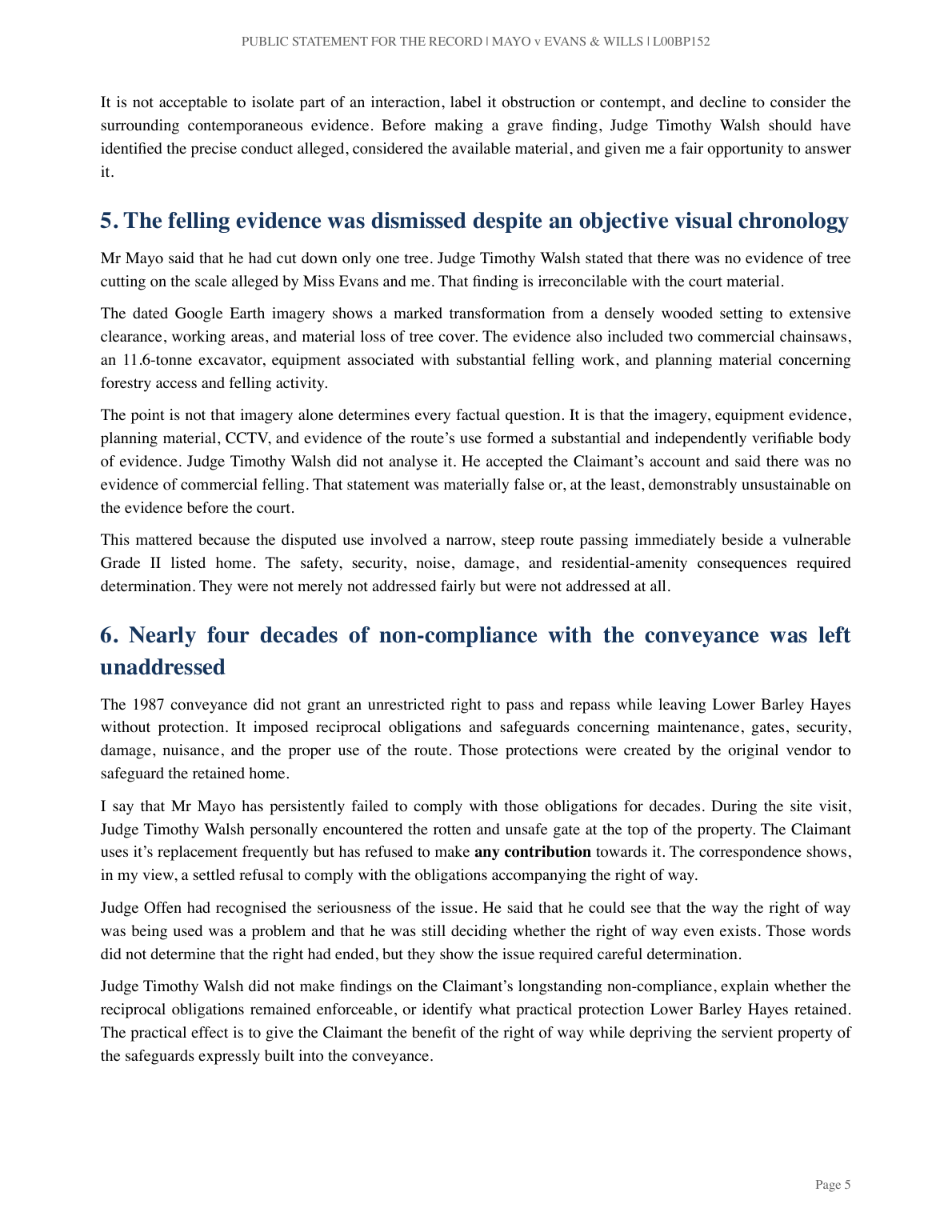
Page 6 — Points 7–10: BH68, boundary, purchase documents and costs.
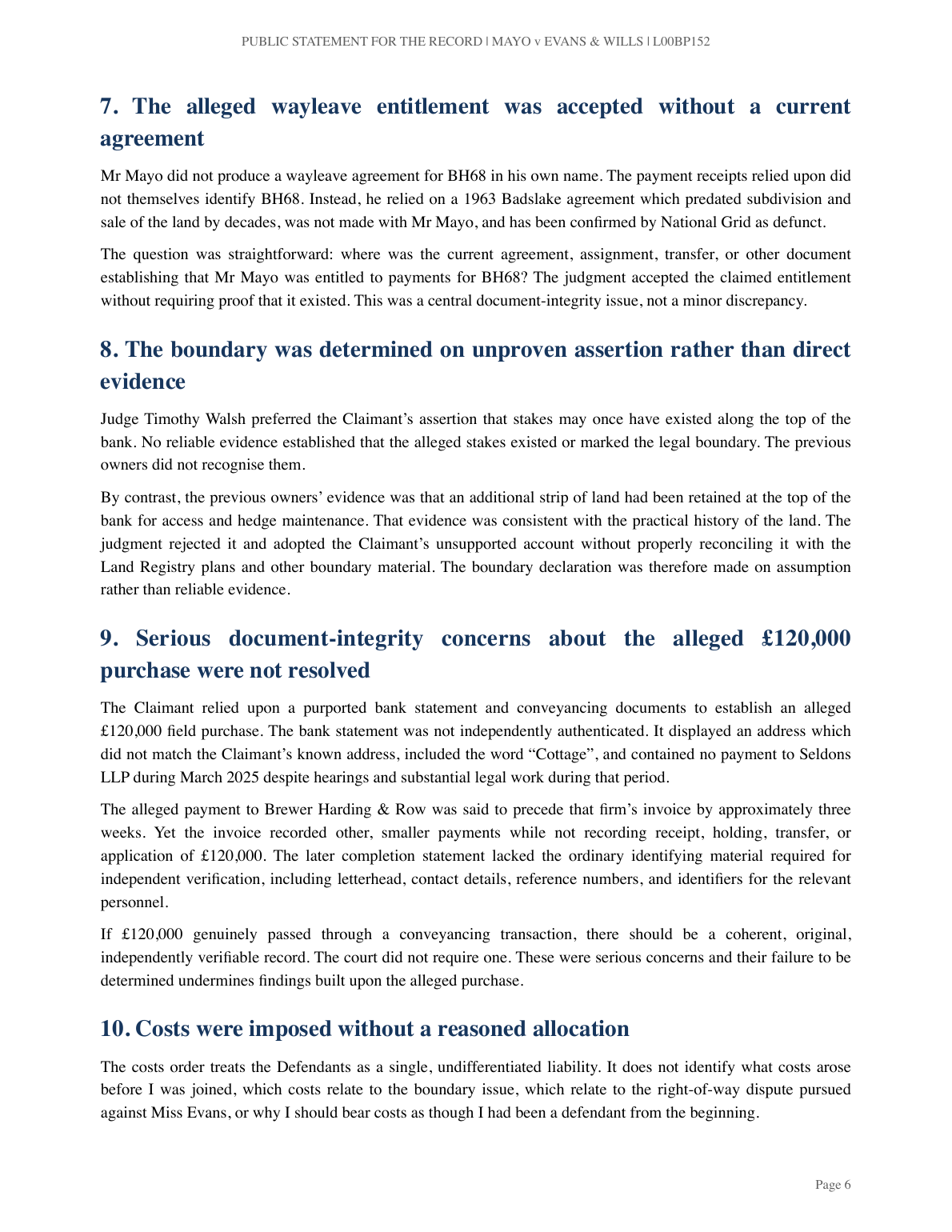
Page 7 — Costs continued; final position, apparent-bias argument and intended appeal.
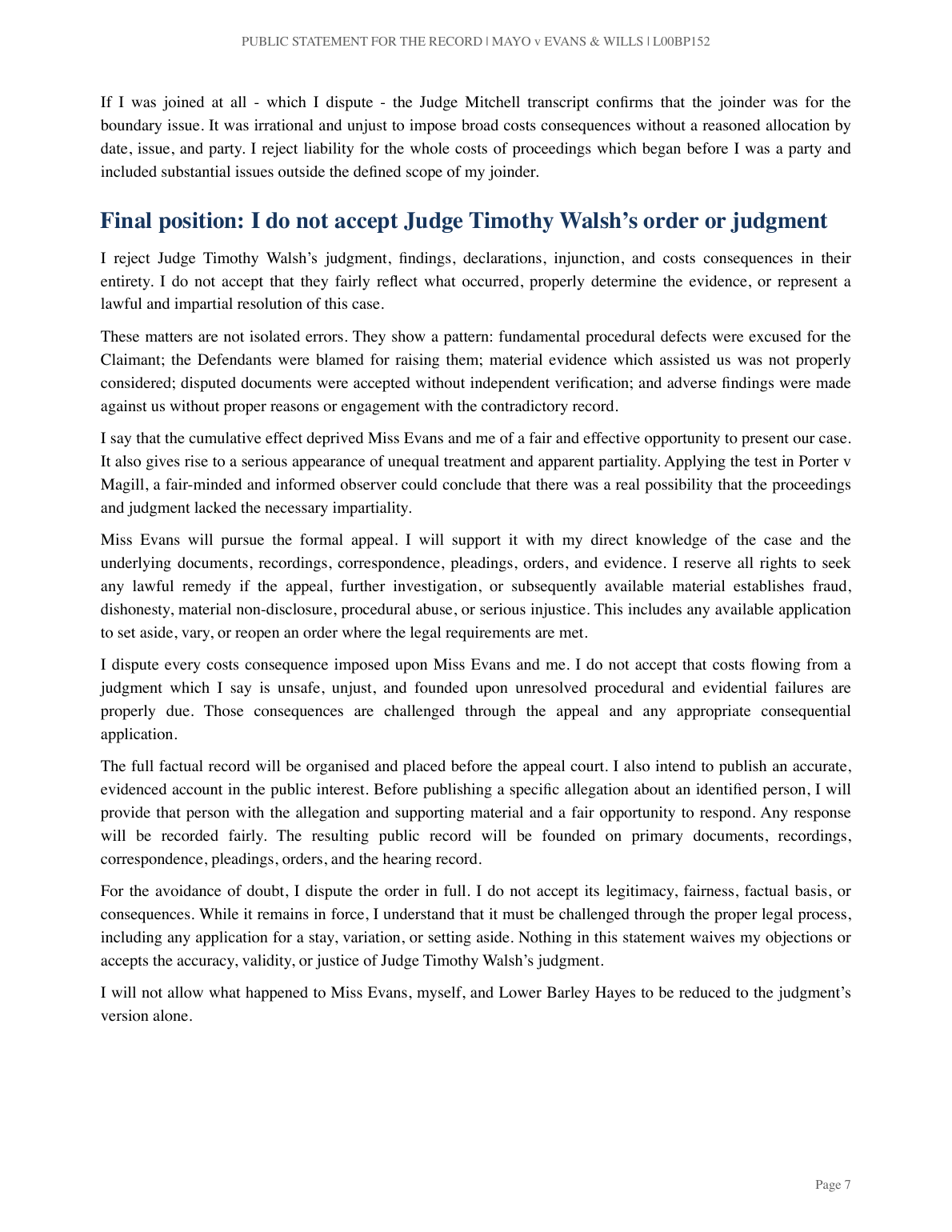
Page 8 — Statement of truth; signed and dated 19 August 2026 in the reviewed copy. Signature/date block and printed name covered.
Put the answers beside the questions.
The statement was sent on 19 August. AP-01–AP-10 are the publication’s new questions, prepared on 22 September 2026; they have not yet been sent by The Unanswered Record. The Barnstaple reply is an automated acknowledgement, not a substantive determination of these challenges.
Any supplied ruling, transcript passage, filing record or substantive reply will be linked to the particular point it addresses. See all questions addressed to Timothy Edmund Walsh →
The next chapter
The statement starts the record. It does not end the challenge.
Miss E’s working rebuttal is now summarised in a dedicated point-by-point section. Her initial filed appeal and eight grounds are now reviewed. Further hearing accounts, orders and transcript passages will extend the record. Each will be linked to the allegation it supports, the date it belongs to and any answer it receives.
This page begins with Mr J’s supporting statement. The statement itself recognises that the order remains in force unless changed through the proper court process, including any application for a stay, variation or setting aside.
The demand remains specific: show how the judgment dealt with the evidence, the objections and the consequences for this family.
The reporting record
What changed in this article.
- New chapter · Eight source pages
The judgment is challenged. Where are the answers?
Mr J’s 18 August statement, signed and emailed to court offices and the civil appeals mailbox on 19 August, is now presented as ten specific challenges with readable page images. The new chapter links the process, evidence and costs questions to their named recipients and will expand with Miss E’s appeal grounds.
Read the ten-point challenge and source pages
Substantive additions and corrections will be recorded here. The full case can be followed through Latest developments.
Stay with the story
Follow the investigation
as the record develops.
Follow what changes when another document, account or answer enters the record.
Follow Daux Scythe, our presenter, on LinkedIn for new reporting, evidence reviews and significant developments. The website remains the home of the articles, documents and response record.
This opens his profile; choose Follow on LinkedIn.